Posts

reading, listening, watching

Reading, Listening, and Watching—It’s That Time of Year Again

2019 has been a YEAR. There as been so much good to celebrate. In March, we welcomed twin girls, Mila and Fiona. This is also (coincidentally?) about the time that we stopped sleeping, reading books, or being able to focus for long periods of time. Lol. So you might wonder what I could possibly offer in the way of recommendations for reading, listening, and watching. 

But as a result of my new normal, I’ve learned that audiobooks are amazing, rekindled my love of podcasts, and enjoyed long(er)-form articles that can be read on my phone, one-handed at previously unknown hours of the morning/night. Yep. This is my new normal and I wouldn’t trade it for the world.

I love a good fresh start—new school year, birthdays, new calendar year. As we head into a new year and a new decade, it feels like the right time to consider the bigger picture. I’m thinking about setting boundaries, creating systems, and being present in my life. I’m asking how I can show up as my best self for myself, my family, my clients, and my community. 

Here are some recommendations from my reading, listening, and watching lists in 2019:

Reading

1. This article: You Don’t Need More Motivation—You Need a System is a great quick read with tips you can implement immediately. 

Staying productive is a challenge for all of us. Whether you consider yourself to be a “procrastinator” or not, the key to sticking to your priorities and getting the important tasks done each day is finding a routine that works for you.

Of course, before you can create the systems that will help you to accomplish your goals, you’ve got to take the time to set those goals. Here’s a set of worksheets I discovered. 

I’m going to work through these over the holidays. Also, vision and goal setting via Lululemon—who knew? 

2. This op-ed: The Inevitable Takedown of the Female CEO has me thinking about the importance of setting corporate culture, our expectations of leaders, and the insidious nature of bias. 

As Audacia Strategies enters its 5th year (Stay tuned for anniversary/birthday celebrations next year!), I’m focused on doing the hard work of building a company where people want to work. We are growing and I’m spending a lot of time thinking about scaling, company culture, and client success. 

I’m also thinking a lot about how to understand what clients need, Audacia’s values and the value our team provides from the client’s perspective. 

3. This manifesto of a company’s “Why” in memo form: We Don’t Sell Saddles Here was sent to the team at Tiny Speck, the makers of Slack, on July 31, 2013—two weeks before the launch of Slack’s ‘Preview Release’. 

Here’s a great quote from the article: “Sell the innovation, not the product. The best—maybe the only?—real, direct measure of “innovation” is change in human behaviour.”

4. This LinkedIn article: After 25 years studying innovation, here is what I have learned reminds us that innovation isn’t one-size-fits-all. 

In the article, the inimitable Clayton Christensen, author of The Innovator’s Dilemma, offers us 5 key findings from his time studying innovation, management, and people. I found #4 particularly compelling. How often do we forget that we are more than our careers and our businesses? Christensen reminds us, it’s easy for high-achievers to “underinvest in their families and overinvest in their careers.”

Listening

1. Click Here to Apply podcast. I’ve been listening to and loving Tony Sheng’s podcast. Each week, Tony interviews interesting people as he tries to figure out what he really wants to do with his own career. 

In one especially interesting episode, Erik Torenberg discusses how we should build career moats. I think this analogy is spot on. If we don’t defend the castle that is our growing business or our career, we risk losing ourselves every time we come under siege.

2. The Startup podcast. I’m that person who learned about the Startup from an episode of This American Life way back in 2014. I’ve been along for the ride with the Startup team ever since and love their (sometimes cringe-worthy) candor in sharing their experiences. So I’m passing on the recommendation.

The final season of the Startup podcast is available on whatever platform you prefer to get your podcasts. This last season charting their path to acquisition by Spotify was really fascinating. 

3. Dan Doran’s interview with yours truly. Speaking of fascinating recommendations (and with apologies for the shameless self-promotion), the episode of Dan Doran’s podcast where he interviews me was his most listened to episode of the year. If you missed it, you can find it here or listen on the Quantive website. 

Do you know of a great podcast looking for a guest like me? Let me know (katy@audaciastrategies.com)! 

Watching

1. The Irishman (Netflix film). I haven’t been as good about watching television lately. BUT we did watch The Irishman the other week. It’s not for the faint of heart, but it was compelling. I’d expect nothing less from an all-star cast of De Niro, Pesci, and Pacino. Special thanks to my husband, Chris, for making me put down my phone to watch it!

2. One Nation Under Stress (HBO documentary). I watched this one during a solo night at home. It’s thought-provoking and resonant for its personal appeal and also the implications for our community at large.

3. The Marvelous Mrs. Maisel (again). We just started Season 3 and I am literally giddy to queue up Amazon and reconnect with Midge and friends after we put the twins down. This show is a breath of fresh air and dialogue #goals. Someday, I’ll have comebacks as snappy as Midge! 

As we wind down another year (and the decade, what?), I hope you’ll take some time to reflect on your year. In the rush to think about our business goals for 2020 and the wonderful, but distracting holiday chaos, it’s easy to forget to really take stock of everything we’ve accomplished. But it’s so important to take the time to look back.

What were your biggest accomplishments in 2019? What are you considering as we head into 2020? What are your recommendations for reading, listening, and watching?

From our family to yours, we wish you a happy and relaxing holiday season and a healthy new year (new decade!).

Photo credit: Jetstream4wd (Getty Images Pro)

crisis management strategy

Your Crisis Management Strategy When You Need to Walk Through the Fire…and Keep Walking

Your company can’t seem to make money, your executives are constantly in the news for the wrong reasons, and your plane still isn’t flying. Yeah. It’s been a rough few weeks/months/years. 

Recently, I talked about what to do at the onset of a crisis, but what happens if you can’t immediately get a handle on the crisis? What is your crisis management strategy for living through the day-to-day of a crisis that seems to go on forever? The initial response with employees and customers requires getting to the ground truth quickly and relaying as many of the facts as you can, while taking action. 

Some of these same elements continue to be relevant in dealing with the fallout of a long term crisis. But what’s crucial for an effective crisis management strategy is being perceived as a company that is moving forward and not one hoping that maybe after enough time passes, everyone will forgive or at least FORGET. When facing damage from a crisis that just will not die, you need a plan for resolution and rebuilding.

Putting Out the Fire vs. Leading Through the Fire

One of the most challenging tests of a great leader is how they deal with a crisis. To pass this test, it takes two skills: knowing how to put out fires and knowing how to lead through fire. 

Every executive has to deal with surprises and being in business likely means you’ll have to put out some fires eventually. Especially as your company expands, those fires will seem bigger, or at least the potential for fires gets bigger. When it comes to putting out the fire of a PR crisis, the name of the game is regaining control. 

For example, you may remember that back in 2016, after the shooting in San Bernardino, the FBI demanded that Apple build a “backdoor” giving the authorities the ability to circumvent Apple’s data encryption and unlock any iPhone. In response, Apple’s CEO, Tim Cook, effectively took control of the story writing this letter: ”A Message to Our Customers.” Tim Cook knows how to put out fires.

However, there are times when you cannot expect to turn things around so quickly or the fires you thought you put out actually continue to smolder. In these cases, leaders must develop a crisis management strategy for continuing to lead even through the crisis. 

Here are some tips for moving forward through the fire: 

1. Continue to focus on transparency and the truth.

While it can be tempting to say whatever you believe will finally put an end to this crisis, resist the urge to “whitewash” the truth. Keep in mind that following your gut and making quick, impulsive decisions is not a valid crisis management strategy and won’t likely get you through this crisis any faster. Impulsive decisions often result in a further loss of power.

Instead, you’ve got to slow down. It will be uncomfortable to tell the truth and only the truth. The media, your employees, your stakeholders, and your customers will likely push for more information. This is difficult to deal with, especially day in and day out. But if you haven’t worked out all the details, do not speculate. Remember that you are engaged in a game of chess here—not rock, paper, scissors. 

2. Work with your team to identify how the firm is preparing to resolve the crisis and (hopefully) prevent another in the future. 

One way to relieve the discomfort of having to stick to the facts, when you don’t have many facts to offer, is to take action so that you have more to talk about. Of course, I’m not suggesting you take any random action that comes to mind. Again, impulsive decisions are almost never the right move.

Instead, work closely with your team to come up with new policies and processes that help your company is ready to move forward. If new training would prevent a similar problem in the future, take steps to implement new training programs as part of your crisis management strategy, for instance. Also, consider what would improve both internal and external communications in the future.

For example, Stanford University recently changed their leave of absence policy for students facing a mental health crisis in the wake of a class action lawsuit alleging discrimination. In her message to students, Vice Provost for Student Affairs, Susie Brubaker-Cole, said, “my colleagues and I have learned from our conversations with you, and our campus community is stronger because of your advocacy.” She went on to say, “together, we are making significant progress, and this new policy is a critical component.”

3. Do NOT stop communicating, either internally or externally. 

No matter what crisis management strategy you ultimately choose, remember to continue communicating as much as possible. Hiding away and hoping you can weather the storm without facing questions from your employees or the public will only cause more problems. 

Instead, keep your leadership visible and ready to answer questions. Have top leaders communicate internally through regular town hall meetings, Zoom meetings, pre-recorded videos, manager talking points, or even just walking through the cafeteria. 

By the way, communicating does not mean you have to take every accusation “on the chin,” but certainly continue to address the issue(s) with employees via your identified channels. Also, be sure to proactively offer appropriate updates to customers, regulators, investors, etc.

Communicate, both internally and externally:

  • What’s the latest 
  • What has changed 
  • What remains the same

Remind your leadership team not to say anything to employees that they wouldn’t say outside the company. This can be controversial, but it’s a reality. Memos leak. Video and audio can be shared. Be transparent and be prepared for what that means inside and outside the company.

4. Focus on sharing your strategy—value proposition. 

This final point is perhaps the most important aspect of any crisis management strategy: go back to the heart and soul of your company wherever possible. It’s a good idea to look at this crisis from a 360-degree angle. Remind your customers why you do what you do and emphasize that you are looking at this issue as only a blip on the radar. 

The point is not to dazzle or distract from the crisis, but to provide context about what your firm does, why, and how you remain committed to that strategy/mission. Ideally, any new processes, policies, actions are in support of continuing to advance the vision of your organization. With surgical precision, you are removing an imperfection and you will be stronger following this recovery. 

Keep this message close at hand, no matter how bleak things look. And always know that every crisis comes to an end eventually. I know that cliches sound so empty when you’re standing in the middle of the chaos and I know you’ve heard them all, but maybe you can take comfort in the words of one great American entrepreneur, Henry Ford, “Failure is only the opportunity to begin again, this time more intelligently.” 

If you’re standing in the middle of a crisis right now, don’t go it alone. Find your tribe. Gather your advocates. And build your crisis management team. Fear might leave you feeling paralyzed at the moment, but you can trust the experts at Audacia Strategies. We’ll help you find the right crisis management strategy. Chaos is our brand, so you can bet we know how to walk through the fire. Contact us and let’s get to work!

photo by Authentic Images

M&A best practices

M&A Best Practices (Part 2): Ensure a Successful Integration After an Acquisition

This is part two of our series on M&A Best Practices. If you haven’t yet read part one, you will want to read it first: M&A Best Practices for before and during an acquisition. And, don’t forget to check out our handy M&A checklist at the end of this article!

In our previous article, we discussed M&A best practices for before and during an acquisition. The entire process can be very dynamic and exciting. For this reason, it’s important to prepare and plan well when things are relatively calm, before you find yourself in the thick of things.

Okay, so you’ve acquired an organization and the communications around the acquisition have gone according to plan. Awesome! Now what? If you’re hoping integration will simply run itself, it’s time to recalibrate your expectations. Just as planning is important before and during an acquisition, establishing timelines and procedures and opening lines for effective communications ensures that integration runs smoothly.

Now, let’s talk about M&A best practices for the weeks and months after an acquisition.

The Work Really Begins: Integrating Legacy Organizations

Effective communications surrounding an acquisition assures your workforce that business will proceed as usual and your clients that delivery is not impacted by this change. Managers are an essential link in the communications chain, both internally and externally.

When announcing an acquisition, the information will spread quickly. And, as we know, false information spreads more quickly than the truth. So you will want to have a strategy to manage your message. Carefully choreograph your communications so that internal audiences hear from you first. Ensure that your communications cascade is timely, coordinated, and that your supporting materials and spokespersons are on point.

Here’s a sample timeline:

  • Day -1, 8pm: A transaction is agreed to and the paperwork is executed.
  • Day 0, 7:30am: The CEO of the acquiring company emails her managers to make them aware of the transaction. The message includes a cover note with action items, timelines, and proofs of concept (POCs). Attachments include a courtesy copy of the all-employee announcement, manager talking points, frequently asked questions (FAQs), and a description of the acquired company.
  • Day 0, 7:30am: Similarly (and ideally simultaneously), the CEO of the acquired company emails his managers to make them aware of the transaction. Like the communication described above, the message includes a cover note with action items, timelines, and POCs. Attachments include a courtesy copy of the all-employee announcement, manager talking points, FAQs, and a description of the acquiring company.
  • Day 0, 8:00am: The transaction press release clears the wire service and then designated communications team members reach out individually to key members of the press.
  • Day 0, 8:00am: The acquiring company distributes a message to the employees of both organizations, announcing the transaction, welcoming the acquired organization to the team, and providing a vision for the future.
  • Day 0, 8:00am: Likewise, the acquired company distributes a message to employees of both organizations, explaining why this decision was made, thanking legacy employees for their service and dedication, and reinforcing the strategy for the combination.
  • Day 0, 8:00am: IT posts all employee communications related to the acquisition on a dedicated intranet page.
  • Day 0, 8:30am: The leadership team holds an all-employee call, reiterating the talking points and allowing for questions.
  • Day 0: 9:30am: Managers hold a huddle with their teams, using provided talking points, then report to corporate communications via email that the meeting took place. This email should also include any questions from employees, which can be rolled into an FAQ document as needed. Track the status of these meetings to identify teams that may require additional communications support.
  • Day 0+: Designated company personnel notify key clients that the acquisition has taken place highlighting the potential benefits to the customer and addressing customer concerns. This can include the heads of associations on whose boards company leadership serve.
  • Day 0+: Leadership calls and all-employee communications provide regular updates on the integration.

Throughout this process, the project team (see Part 1) meets to ensure deadlines are continuing to be met, issues are raised, and questions are answered. The project manager and assistant/deputy remain engaged with the collective plan, as well as with each department lead. As the combined organization achieves milestones, large or small, celebrate those!

Culture is a critical influencer in any acquisition. If employees within the acquired organization feel that things are changing radically early on, they may not buy into the change, and they may seek opportunities elsewhere. Rely on project leads to provide “temperature checks” and suggest ways to unify the group, if needed.

 Take time to take stock. There are always lessons to be learned following a significant transaction. As the dust settles, be sure to complete an after-action review to garner feedback on what went well, what could have gone better, and what should be taken into account in the future. This is also a good time to review templates and procedures that worked well and will be helpful to future activities. 

There you have it, your complete Audacia Strategies blueprint for M&A best practices before, during, and after. When you combine these tips for integrating a newly acquired organization with the tips for preparing and announcing the acquisition in the early stages, you have a recipe for M&A success. 

Here’s a handy checklist we use when working with our clients throughout the process. Are you ready to see us in action? Schedule your consultation and let’s get you on the books. We’re ready to help your organization transform and grow!

Image by rawpixel from Pixabay

M&A best practices

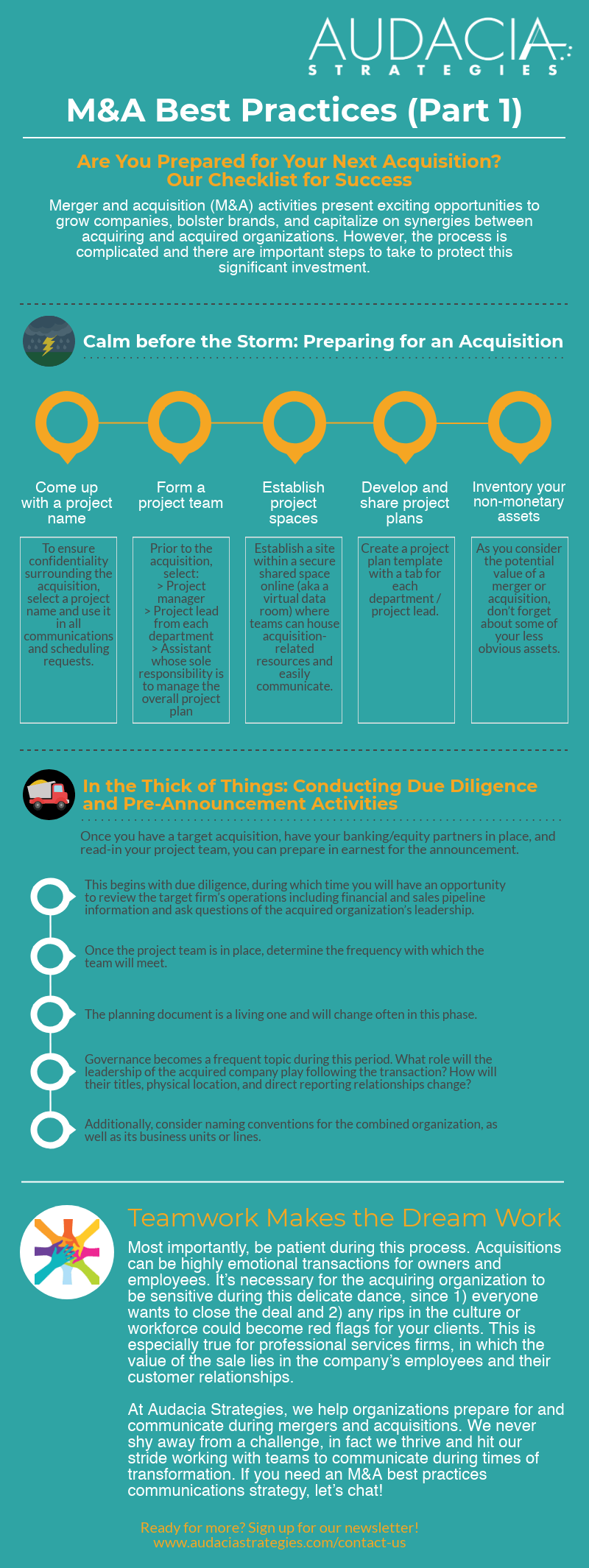
M&A Best Practices (Part 1): Are You Prepared for Your Next Acquisition? Our Checklist for Success

This is part one of our series on M&A Best Practices. Tune in for the exciting conclusion: M&A Best Practices for after an acquisition.

Merger and acquisition (M&A) activities present exciting opportunities to grow companies, bolster brands, and capitalize on synergies between acquiring and acquired organizations. However, the process is complicated and there are important steps to take to protect this significant investment.

The stakes are high. One article by Harvard Business Review reports that more than 70 percent of all M&A activities fail. While preparation and planning makes a difference at any stage, following M&A best practices are especially helpful in easing the strain of the due diligence and announcement processes. 

In the following article, we recommend M&A best practices to apply before and during an M&A activity to ensure positive outcomes for all parties.

Calm before the Storm: Preparing for an Acquisition

Proper planning and forethought in the months and weeks prior to your company acquiring another organization will save you time during the announcement and integration periods and avoid role confusion. It will also assist your workforce in managing change. 

best practicesIn the weeks prior to an acquisition:

  • Come up with a project name. Once you select a company you plan to acquire, e-mail exchanges will increase dramatically and a significant number of meetings will appear on calendars. To ensure confidentiality surrounding the acquisition, select a project name and use it in all communications and scheduling requests. This small step will help a lot when it comes to organization.
  •  Form a project team. Prior to the acquisition, select:

 > A project manager who will have the internal relationships and executive respect to enforce plans and deadlines, press leadership for decisions, etc.

 > A project lead from each department. This is a great opportunity to elevate high-potential employees. Tap the talent within your organization to work on a project that will have a huge impact.

> An assistant or deputy whose sole responsibility is to manage the overall project plan and support the team through upcoming deadlines/outstanding actions. Do not leave this role vacant. While it may seem that everyone can keep track of their own deadlines, that is a recipe for disaster. For the sake of accountability, it’s best to have someone else managing the timeline. 

  • Establish project spaces (both virtual and physical). Establish a site within a secure shared space online (aka a virtual data room) where teams can house acquisition-related resources and easily communicate. Every department/lead should have a defined space to house documents and review, edit, comment. Additionally, if you have a cohort of team members in one place, consider the physical location(s) where meetings will take place. Is it possible to reserve a private war room for the team’s exclusive use?
  • Develop and share project plans. Create a project plan template with a tab for each department/project lead. This could look similar in format to a Transformation Management Office (TMO) plan. This is helpful for keeping track of all of the moving pieces and identifying interdependencies.
  • Inventory your non-monetary assets. As you consider the potential value of a merger or acquisition. Don’t forget about some of your less obvious assets. What BD, HR, IT, finance, legal, recruiting, training, and other systems do you own or lease? What subscriptions do you hold? What memberships are committed and paid? What marketing equipment do you own? During the very busy integration process, you’ll want to understand where there are potential synergies and potential conflicts. Ask the same of the acquired organization in order to realize savings and achieve synergies. Save time on your end by coming up with this list now.

In the Thick of Things: Conducting Due Diligence and Pre-Announcement Activities

Once you have a target acquisition, have your banking/equity partners in place, and read-in your project team, you can prepare in earnest for the announcement.

  • This begins with due diligence, during which time you will have an opportunity to review the target firm’s operations including financial and sales pipeline information and ask questions of the acquired organization’s leadership. Time is precious and planning should run concurrent to the due diligence process.
  • Once the project team is in place, determine the frequency with which the team will meet. Likely, this will be daily during the pre-announcement period, then weekly during the integration.
  • The planning document is a living one and will change often in this phase. During team meetings, assess where tasks stand in relation to deadlines, what hot spots might flare, and what decisions are needed.
  • Governance becomes a frequent topic during this period. What role will the leadership of the acquired company play following the transaction? How will their titles, physical location, and direct reporting relationships change? It’s important to think this through instead of making assumptions. If employees don’t see a clear hierarchy and know to whom they are expected to report, chaos will be the likely outcome.
  • Additionally, consider naming conventions for the combined organization, as well as its business units or lines. Does the company name change? Does the acquired organization become a business unit, a subsidiary, or a portion of an existing business line? The answers to these questions will impact everything from the website(s) and corporate signage to stationary and e-mail signatures. Consider how you can engage employees and even customers in the re-branding process. For the best results, engage a professional as well!

One note of caution: Often, the creation, review, and approval of announcements, manager talking points, FAQs, press releases, and online content will reveal decisions that haven’t yet been finalized or information that has not yet been disseminated to the entire project team. Be conscientious about version control as you may need to do a significant amount of coordination within your team and with your external advisors (legal, banking, etc.) during this phase.

Teamwork Makes the Dream Work 

Most importantly, be patient during this process. Acquisitions can be highly emotional transactions for owners and employees. It’s necessary for the acquiring organization to be sensitive during this delicate dance, since 1) everyone wants to close the deal and 2) any rips in the culture or workforce could become red flags for your clients. This is especially true for professional services firms, in which the value of the sale lies in the company’s employees and their customer relationships. 

At Audacia Strategies, we help organizations prepare for and communicate during mergers and acquisitions. We never shy away from a challenge, in fact we thrive and hit our stride working with teams to communicate during times of transformation. If you need an M&A best practices communications strategy, let’s chat!

In our next blog article, we discuss M&A best practices in relation to running a smooth integration after an acquisition and we’ll summarize everything with a checklist you can put to use. Stay tuned!

Image by rawpixel from Pixabay

failure communications

How To Do Failure Communications Right—3 Communications Lessons Learned About What To Do When We Fall

We naturally spend a lot of time thinking about what a successful communications strategy looks like. This a good thing. Communicating your company’s message and values is crucial for standing out amongst your closest competitors. But have you also thought about a failure communications strategy?

<INSERT> Awkward silence.

failureRight. Let’s get uncomfortable today. Let’s talk failure. If you’re rolling your eyes now because you think you know what’s coming, keep reading. This isn’t going to be the “Failure is an amazing teacher!” pablum that we’ve all grown so tired of hearing. No. This is real talk about what to do when the sh*t hits the fan, when we disappoint ourselves and others, or when we just fall flat on our faces.

Rothy’s and How to Do Failure Communications Right

I recently received an email from shoe startup, Rothy’s, that stopped me in my tracks (Yes, Rothy’s is a favorite brand of mine. But don’t worry, this is not an endorsement or a sales pitch. It’s just an example of an excellent communications strategy). 

For months, Rothy’s had been teasing its latest shoe, a summertime slide with a vegan leather sole. The day before the shoe was supposed to launch, Rothy’s told its customers that the shoe’s launch was off. Apparently, scaling from prototype to production resulted in quality issues that couldn’t be fixed in time for the summer season.

The email they sent wasn’t a sale announcement or a giveaway begging customers not to leave. The subject line was: “Ouch.” The first line included the words “truthful and transparent.” It was an apology. But not the kind of lackluster corporate apology you might expect from a CEO who is clearly following instructions provided by legal. It was the kind of apology that left me feeling a greater respect for Rothy’s and its leadership.

What Rothy’s apology got right:

  • They took responsibility both for the mistake and for the decision to cancel the launch of a new product
  • They explained why they made the decision to cancel the launch
  • The reason they gave was all about looking out for the customer
  • They referred to their company values (i.e., “we pride ourselves on making the right decision—even when it’s really hard”) and their quality standards (i.e., “we will only launch product when every piece is perfect”)
  • They acknowledged how disappointing this decision is, but reiterated their confidence in making this difficult decision

They sent this email the day before the launch. 

Think about that—consider the time and money invested in design, marketing, production. Consider the sales expectations already baked into the firm’s annual plans. Think about the discussions that were likely happening behind the scenes to make the decision to pull the launch just hours before it was scheduled. Yet, they went through with the apology because leadership believed it was right.

3 Lessons Learned From Rothy’s Apology

If you stay in business long enough, failure is inevitable. Every seasoned business leader has “war stories.” Failure hurts. It hurts to consider the financial impact. It hurts to consider the customer impact and the blow to your brand (or personal) credibility. And, let’s be honest. It’s an ego blow. 

What sets apart those who master the art of turning lemons into lemonade from those who just leave customers with a sour taste? Let’s look at 3 lessons we can learn from Rothy’s literal failure to launch.

1. Failure can humanize your brand.

Failure sucks—there’s no getting around that—and doing the right thing can be incredibly painful. But as you work through the failure, acknowledging the pain humanizes your brand and aligns your goals with your customers’ expectations. 

When you fail, make it right if you can. But when you can’t, acknowledge the human aspects of disappointment and talk openly about how you will do better going forward. Trust your customers enough to put it all out there.

2. Transparency works.

Whether you’re communicating with customers, investors, or media, prioritize simple honesty. We don’t have to martyr ourselves or get too far into the weeds of how and why we failed. But we should be honest about the situation and what we’re doing about it. At the end of the day, this is all anyone can expect after a crisis. You can’t turn back time as much as you might wish you could.

3. Live your values. 

Failure is the greatest test of your values as a company. This really is where the “rubber meets the road.” After Facebook admitted to selling our data, one of the biggest criticisms was really a question about the company’s values. The “apology” ad reminding us of how much we all love Facebook felt like a sham after everything that came out. 

Communicating about failure, when done right, gives us a chance to remind others about our values, why they are important, and how they provide a better experience. That’s what I liked the most about Rothy’s communication. They acknowledged the failure right up front and they explained their highly personal calculus behind pulling the launch: that the poor quality shoe would be a bigger hit to their brand credibility than not launching the shoe at all. 

It was a fantastic example of transparency, honesty about business decisions, and a real example of living your corporate values. I’m sure that behind the scenes at Rothy’s HQ there are some heavy discussions taking place to understand why they failed on this product launch. But, they lived to fight another day and made their customers feel prioritized. 

Rothy’s launch fail is an excellent example of making lemonade out of lemons. You can perfect your brand’s lemonade recipe with these other blog articles:

And you can always work with a pro like Audacia Strategies to establish your failure communications or crisis communications strategy. We can also help create a strategy for successful communications, of course! Contact us today to talk about your unique needs.

Image by rawpixel from Pixabay

best communications practices

“Chaos is Our Brand”—Takeaways from an Interview with Katy Herr, CEO of Audacia Strategies

Friend of Audacia Strategies and CEO of Quantive, Dan Doran, interviewed Katy about the advantages of running an “out-of-house” communications firm, best communications practices during times of transition, investor relations, M&A strategy, Amazon’s acquisition of Whole Foods, and much more.

Here are some of the biggest takeaways and highlights from their in-depth conversation.

1. Don’t Wait to Create a Communications Strategy

Organizations most often look for experts in investor relations and strategic communications during big transitions. For example, a government contractor might decide to take operations in a commercial direction or a firm may contemplate a game-changing merger or acquisition. Whether or not your organization ultimately decides to bring in a firm like Audacia Strategies to help during such a transition, the most important thing you can do is start strategizing early.

Many of our clients contact us when they’re facing one of two situations: times of crisis or times of transformation—hence our unofficial tagline: “chaos is our brand.” This makes a lot of sense, but too often what we find is that if an organization hesitates to develop best communications practices and a communications strategy early enough, things can go off the rails quickly.

Say your board is about to fire your CEO, when someone leaks the news on social media and all hell breaks loose. What do you do now? Dealing with this kind of challenge is never fun, but it is much easier if you have a strategy ready to implement. If you have a plan, you can stabilize the situation quickly and move past the crisis.

So, why look to an outside “hired gun” to help develop a best practice communications strategy?

Here are a few of the benefits of using an outside communications firm like Audacia:

  • An outside set of eyes gives you transaction experience, critical perspective, and unbiased advice when communicating your message to the outside world.
  • An outside firm is in a good position to place your organization in a broader context (i.e., the competitive set, the market, and your financial stakeholders), while you focus on running day-to-day internal operations.
  • An outside firm isn’t influenced by the “groupthink” or silo-ed communications that can be an obstacle to projecting the strongest public image.

2. Think About Who Your Stakeholders Are

Part and parcel of creating a winning communications strategy is thinking about who your stakeholders really are. Whatever you do, don’t skimp on the stakeholder analysis. Remember that at its core communications is about storytelling. And just as you wouldn’t tell the same story in the same way to your 4-year-old nephew as you would to your 85-year-old grandmother, you wouldn’t tell the story of your company in the same way to different types of stakeholders.

Depending on whether you are a publicly or privately held company, stakeholders could include any or all of the following sets:

  • Employees
  • Financial stakeholders:
    • Public debt holders and ratings agencies
    • Private equity companies and banks
  • Community partners
  • Business partners (non-financial)
  • Strategic partners
  • Customers

3. Understand the Difference Between Marketing and Communications

It’s also important to realize that even if you have an internal marketing department or marketing agency responsible for communicating your message to customers, you may still benefit from enlisting a corporate communications or investor relations firm to help communicate with other stakeholders. We see both marketing and communications as valuable tools for building relationships.

Whereas marketing primarily focuses on telling the story of how your product or service will help your target customers, strategic communications partners can knit together the entirety of the business story to give investors and other stakeholders a comprehensive picture. As experts, we provide you a strategy leveraging communications best practices honed over many transactions, crises, and change events.

We look at how individual aspects of the business including operations, business development, human relations plans, contracts, real estate holdings, etc. fit together to create a holistic picture of value and determine how to communicate that value to each stakeholder segment.

In addition, while many firms have annual strategic planning sessions, often leaders and employees are too busy putting out fires day-to-day to think much about the broader picture. By opening this conversation, we give firms the space to look at the competitive space and customer environment, for instance, and ask big questions about how their market might respond to their actions, how resources should be optimally redirected, and how to keep investors engaged through the transition.

4. Gain Fundamental Communications Building Blocks Regardless of Revenue

At Audacia Strategies, our team has worked to develop best communications practices for companies with billions in revenues and an established shareholder cohort and companies that are pre-revenue looking for their first round of funding. While the scale and scope are different, the communications needs of large and small firms are remarkably similar.

There are some “blocking and tackling” basics that hold when it comes to analysis, building customer relationships, and considering how to communicate your value to the marketplace. These are fundamental whether you’re pitching friends and family or venture capital firms.

Fundamental communications questions to ask:

  • How do we want to talk about this new capability?
  • How do we demonstrate knowledge, understanding, and awareness of the market we’re going into?
  • Are there legal, financial, or cultural requirements that we should keep in mind?

5. M&A Tips and Tricks

When it comes to M&A (mergers and acquisitions), Audacia Strategies can support teams in many different capacities. We work with corporate development teams, in-house financial teams, lawyers, and investment bankers helping them think through the market and storytelling from an M&A perspective. For publicly traded firms, given the disclosure requirements, if you can tell the right story from the beginning, the whole process will be easier.

For example, when murmurs of Amazon working on a deal to acquire Whole Foods first hit the news, a lot of experts were skeptical. Whole Foods was struggling against some PR snafus and people wondered what Amazon really knew about how to manage a grocery store.

But look at what happened? As soon as Amazon acquired Whole Foods for $13.5 billion, Amazon’s market cap went up $14.5 billion. Essentially, the market paid Amazon to acquire Whole Foods. (If you’re curious to read more about Amazon, check out The Everything Store.) So, it’s interesting to see how the market will view M&A. It’s about risk, the ability to manage the risk, and telling the story of how this acquisition fits into your broader business strategy and culture.

Finally, we’ll leave you with some pitfalls and opportunities to consider when it comes to communications during a merger or acquisition:

M&A Pitfalls:

  • Companies that overpay: We have another blog post dedicated to this topic. Suffice to say, if you overpay for an acquisition, it can create credibility issues with your investors, your Board of Directors, your employees…the list goes on. Negotiations can get emotional quickly but consider that the business strategy will have to support the valuation.
  • Cultural fit failure: We’ve seen it happen: a small start-up firm develops an amazing technology and gets bought by a huge firm looking to prove it’s innovative and “hip.” Then, within a year, all the original start up employees are gone. Avoid this kind of cultural disconnect by having an air-tight integration strategy from the beginning. Make sure you are walking your walk, so you can deliver on what you’re promising.

M&A Opportunities:

  • Integration is key: The best M&A success stories are those where the merging leadership teams think about integration all the way along. When companies have a successful communications strategy that includes communicating the big vision well for both internal and external audiences, the proof is in the stakeholders’ response.
  • Customers see opportunities: Ideally, when two companies merge, customers say “this is exactly what I needed.” Rather than seeking out two solutions, for example, the customer gets one-stop-shopping from the new hybrid. It’s your job to help communicate this feeling across your stakeholder groups.
  • Employees see opportunities: And if you can also pull off a merger where employees in both companies see the transformation as good for their own careers, you’ve developed a winning communications strategy. Often employees of the smaller firm may feel anxious about being acquired. But if you can honestly demonstrate opportunities for career mobility, earnings potential, and other benefits of working for a larger company, it will go a long way toward easing transition tensions.

The above is only a sampling of the insights and best communications practices gained from Dan and Katy’s conversation. To watch and listen to the 30-minute interview in its entirety, hop over to GoQuantive.com.

Catch the whole episode here:

For more information about how Audacia Strategies can help you own your message through big bold business changes, check out our one-page business overview. And if you’re new to the Audacia Strategies world, welcome! Please contact us to set up a discovery session so we can start strategizing about your best communications practices now.

Photo credit

M&A issues

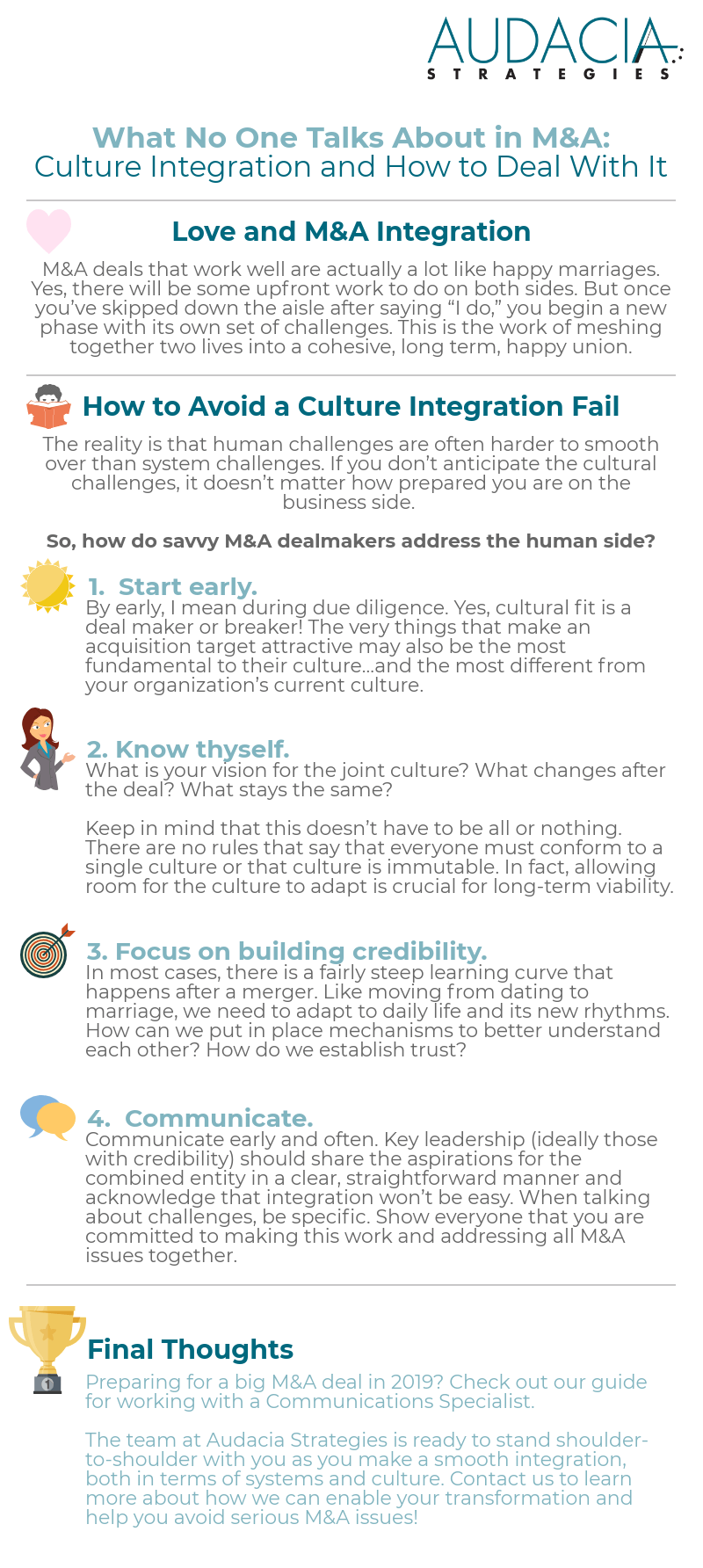
What No One Talks About in M&A: Culture Integration and How to Deal With It

We’ve talked about M&A before—the pros, the cons, where deals can go off the rails—but now let’s talk about what happens after the deal is closed. What comes next and what M&A issues come up?

Once your deal closes and the dust settles, it’s time for the real work to begin: integration. With any luck, you’ve already done some focused thinking about integrating the two firms. You’ve looked at M&A issues such as aligning billing systems, benefits plans, compensation strategies, etc. and you have strategies for each.

But what about culture? What’s your strategy for culture integration? If your reaction here is anything like, “A strategy for culture integration? Oh, the department heads will handle all of that,” you will probably want to keep reading.

Love and M&A Integration

M&A deals that work well are actually a lot like happy marriages. Yes, there will be some upfront work to do on both sides. But once you’ve skipped down the aisle after saying “I do,” you begin a new phase with its own set of challenges. This is the work of meshing together two lives into a cohesive, long term, happy union.

An M&A transaction can be a bit like courtship (ah, and you thought chivalry was dead): You date around for a bit, decide that you’ve found “the one,” get engaged, and then, you throw a heckuva wedding. And when you wake up after the honeymoon, reality sinks in…the thoughts start flying.

  • Thought Bubble #1: For better or for worse…wait, you didn’t tell me about that billing issue!
  • Thought Bubble #2: For richer or for poorer…what happened to the sales pipeline we reviewed?
  • Thought Bubble #3: ‘Til death do us part…why are all the employees leaving?

And as with any new marriage, there are logistical M&A issues that no one really considers before they sign on the dotted line:

  • How are we going to celebrate holidays? (Is everyone onboard and motivated by how we recognize and celebrate success?)
  • How should we handle joint finances? (Do both parts of this new mixed organization share the same fiscal priorities?)
  • How often do I have to see your family and friends? (What’s our customer relationship strategy?)

I’m not suggesting that the key to successful M&A integration is scheduling time for employees to do a bunch of trust falls and escape room activities. What I’m suggesting is that you consider how culture impacts any business transaction in the same way you consider how to maximize earning potential for shareholders.

Lessons from a Culture Integration Fail

Early on in my career, I worked for a multi-billion dollar firm. With much fanfare, we acquired a smaller firm that was highly respected and well-known in the industry for its creativity in “getting things done” for customers.

Within a year of acquiring the firm, the larger company had overlayed all of their big company processes and requirements onto the smaller firm—squashing the very flexibility and creativity for which they had been known (and for which we had acquired them!). Unsurprisingly, half of the employees were gone within 2 years…as were the customers.

While it’s easy to see the internal (e.g., from the employees’ perspective) impact of cultural M&A issues, we don’t often think about the external (e.g., from the customers’ perspective) impact. However, culture certainly does impact customer experience and this is especially true after a merger. For a case study in how NOT to complete a successful integration, check out the Starwood / Marriott merger. Yikes!

The hard lesson learned here: The reality is that human challenges are often harder to smooth over than system challenges. If you don’t anticipate the cultural challenges, it doesn’t matter how prepared you are on the business side. So, how do savvy M&A dealmakers address the human side?

1. Start early.

By early, I mean during due diligence. Yes, cultural fit is a deal maker or breaker! The very things that make an acquisition target attractive may also be the most fundamental to their culture…and the most different from your organization’s current culture.

Make sure that someone on your team is putting together a culture strategy prior to the close of the transaction. At a minimum, this strategy should include:

  • Key metrics for competitive landscape, demographic, and market trends to discuss with leadership.
  • Outlines for any necessary cultural change initiatives (Tip: stick with no more than 2 major change initiatives during the first year).
  • Ideas for creating employee buy-in and a sense of community.

2. Know thyself.

What is your vision for the joint culture? What changes after the deal? What stays the same?

Keep in mind that this doesn’t have to be all or nothing. There are no rules that say that everyone must conform to a single culture or that culture is immutable. In fact, allowing room for the culture to adapt is crucial for long-term viability.

Why are these firms merging? What is valued in each and how can we take the best pieces of our cultures and bring them together respectfully?

3. Focus on building credibility.

In most cases, there is a fairly steep learning curve that happens after a merger. Like moving from dating to marriage, we need to adapt to daily life and its new rhythms. How can we put in place mechanisms to better understand each other? How do we establish trust?

Remember that credibility is earned, not given. When a large firm acquires a smaller firm (especially if the smaller firm was once a competitor), there can be some apprehension. It’s important to warn employees of the large firm that taking a victory lap is not appropriate.

Past is not prologue. So the acquiring firm should look to create the right environment to nurture a bright future and bring the new acquisition into the fold. This will require transparency in sharing plans, following through, listening when challenges are raised, and addressing the concerns of everyone.

This is a key building block for #4.

4. Communicate.

Communicate early and often. Key leadership (ideally those with credibility) should share the aspirations for the combined entity in a clear, straightforward manner and acknowledge that integration won’t be easy. When talking about challenges, be specific. Show everyone that you are committed to making this work and addressing all M&A issues together.

Employees need to know what’s changing, why, when, and what will happen, both in the overall big picture, as well as on a day-to-day basis. They need to understand what the merger means for them and what the new expectations will be.

Communicating is about way more than printing off new motivational posters with the company’s core values and firing off a few “rah-rah” emails. (GAH!!) Cultural integration requires a change management focus, leadership commitment, transparency, a willingness to listen (and integrate) feedback, and continued communication via as many channels as possible…even when you think you’re done, you’re not. Keep going. Like a marriage, you’re in this for the long haul.

Preparing for a big M&A deal in 2019? Check out our guide for working with a Communications Specialist.

The team at Audacia Strategies is ready to stand shoulder-to-shoulder with you as you make a smooth integration, both in terms of systems and culture. Contact us to learn more about how we can enable your transformation and help you avoid serious M&A issues!

Photo credit: rawpixel.com

reading

Reading, Listening, and Watching—What I’m Loving Right Now

It’s always fun to share and hear from others what they’re reading, listening, and watching. But in the frenzy of launching new products, bringing on new staff, and all the other things that go into growing our businesses, who has the time, right?

Fortunately, as we wrap up loose ends on 2018 and (hopefully) find ourselves with a bit of downtime, we have the headspace to expand our minds. I’ve been gathering the resources for my reading, listening, and watching pleasure on flights and quiet evenings by the fire. As you do the same, I thought you’d find this list beneficial.

Here’s what I’m reaching for in these moments of productive downtime:

Reading

True Story: My husband calls my Kindle my “boyfriend” because it’s always with me—when I travel, when I treat myself to a quiet lunch, and before bed. It’s my go-to. But the truth is a few years back, I noticed my attention span was dramatically shorter. After a bit of introspection, I found that I had stopped reading long-form materials in favor of reading email newsletters, social media, and skimming news articles. I made a commitment to read more and it has brought such joy into my life. I read across the spectrum—fiction, non-fiction, memoirs, cookbooks…you name it, I’ll read it. What should be on my list for 2019?

reading listening watchingHere are some of my favorite books from 2018 (plus, my favorite daily must reads):

1. Bad Blood

Nope, Bad Blood is not the lyrics to that TSwift earworm (you’re welcome!), but a real-life thriller that charts the rise and collapse of Theranos, the multibillion-dollar biotech startup. Wrapped in a page-turning package, there are many lessons to be learned about the importance of leadership, the role of the Board of Directors in governance, and the importance of a moral compass in maintaining the soul of a company as we tread more and more deeply into technology.

And you don’t have to take my word for it. Bill Gates recommends Bad Blood too.

2. The Everything Store

I was a bit “late to the party” in reading this book. It was initially published in 2013. However, it remains an insightful look into how the Goliath, better known as Amazon, came to be. More importantly, it’s a incisive look into the mind of Jeff Bezos—what makes him tick, his management style, and how he has shaped Amazon’s culture and strategy. In a time when we spend a lot of time and spill a lot of ink thinking about Amazon’s unprecedented growth, The Everything Store provides an interesting perspective. I found the book incredibly eye-opening as an Amazon customer, a global citizen, and as a business owner.

3. The Hate U Give

“What’s the point of having a voice if you’re gonna be silent in those moments you shouldn’t be?” — The Hate U Give

Fun fact: My mom spent over 20 years as a children’s librarian and is an absolutely voracious reader, so when she recommends a book, I listen. The Hate U Give isn’t a kids’ book though. It will speak to your teenagers, but it should be required reading for all of us. Profoundly moving, The Hate U Give handles gun violence, income inequality, a history of segregation, activism, and police brutality, while also managing to build in relatable, real-life characters and cozy, quippy family banter. Fans of the signature banter of Aaron Sorkin (see also: The West Wing) will appreciate the crisp dialog. I experienced a full range of emotions while reading this book. It made me think about the role of community, government policies, and how we can all do more to build safe communities. (Full disclosure: I haven’t seen the movie that came out this fall. But, even if you have seen the movie, I strongly recommend reading the book.)

Daily reading: (Note: I am not affiliated with any of the following website or brands, nor am I a sponsor. I’m just a fan.)

  • Axios Newsletters: Bullet points, easy to read, well-researched and cited. A great way to hit the morning headlines from major publications punctuated with outstanding commentary and  insight (subscribe here).

I read these almost every day:

  • Axios AM
  • Axios Edge
  • Pro Rata
  • Axios Sneak Peek (Sunday)

Listening

I’m a HUGE podcast fan. I listen to podcasts almost exclusively while I run and while I’m walking around D.C. There is just something about a great story—fiction or non-fiction. Here are a few of my favorites. What are you listening to these days?

1. The Pitch

If you like Shark Tank, you’ll enjoy The Pitch.

The Pitch puts you inside the room of a live pitch and then shares the behind-the-scenes details of what folks “really” thought and what happens after the pitch. It’s great for entrepreneurs, anyone working with entrepreneurs, or anyone responsible for selling anything… including themselves.

2. Planet Money

Planet Money is an NPR podcast that helps to make sense of the complexities of economics and the economy. They often use creative examples and in-depth reporting. For example, they made a t-shirt and traced the supply chain around the world, launched a satellite (one of my favorite episodes—totally fed my space geek side), and built an algorithmic trading Twitter bot.

3. How I Built This

Another NPR show, How I Built This has gained legions of fans and I’m one of them. You’ll hear straight from the founders how their companies came to be…and sometimes almost didn’t! AirBnB, Burton Snowboards, Whole Foods, StitchFix, Lyft, DryBar—you’ll hear from companies that we interact with or read about regularly. And you’ll hear about the genesis of the idea for the company, how they grew, got funded, what worked and what *almost* pulled them under.

Audio Book:

The Year of Yes: How to Dance It Out, Stand in the Sun, and Be Your Own Person

Stay with me here.

Yes, it has a very self-helpy title. It’s Okay. I promise. This is a super funny book. Don’t write it off. And…okay, technically, it is a book. But I listened to the audio version and I recommend that you do the same. Shonda Rhimes (the creator, head writer and executive producer—of Grey’s Anatomy, Private Practice, Scandal, How to Get Away with Murder, and several other shows) tells this compelling and laugh-out-loud funny story of how she stopped saying “no” to opportunities, started saying “yes,” and the changes that resulted. If you’ve ever felt like you needed a bit more “why not?” in your life, you will appreciate her story. And, if you have a commute this book will make your time on the road fly by.

Watching

Admittedly, I’m not great with television. I’ve watched my fair share of shows, but I’m not a good “binger” of television and I’m always behind on the latest and greatest. (Confession: I’ve never seen Breaking Bad…I think that might be a cultural crime at this point). But, I do have a few recommendations for shows that I found compelling this year. What did I miss?

1. Panic: The untold story of the 2008 financial crisis

With stellar reporting from the Vice team for HBO, this documentary tracks the financial crisis that took hold during the Fall of 2008 and provides real-talk about what caused the crisis and what happened behind the scenes as policy makers, legislators, and corporate titans attempted to avoid a global financial collapse. The creators managed to interview all of the key players in the 2008 financial crisis: Bernake, Paulson, Obama, Bush (W.), Dimon, Buffett, and many more. It’s well-researched, well-reported, watchable and very scary. This should be required viewing for all leaders and, especially, communicators. The lessons for crisis management and crisis communications are innumerable. Just watch it!  

2. The Marvelous Mrs. Maisel (Seasons 1 and 2)

I’m addicted to this show. In an era of dystopian dramas (and yes, I’ve watched many of those too), this show manages to be funny, optimistic, and timely all at once. The dialog is snappy and on point and Tony Shalub plays a pitch perfect role, as always. If you need a break from the drama of real life The Marvelous Mrs. Maisel is a wonderful way to escape for a bit.

3. The Greatest Package Theft Revenge of All Time

If you’ve ever had a package stolen, you’ll appreciate the karmic justice in this short video. And, if you’ve never had a package stolen (lucky you!), you’ll appreciate the engineering that went into this project. If you’ve ever wondered what NASA engineers do in their spare time, this is a must watch!

As you enjoy some much deserved R&R over the next couple of weeks, I hope you’ll spend some time with some inspirational and fun content. And I’m always looking for recommendations, so if you have any must-read, must-listen-to, or must-watch suggestions for me, please send them my way.

Happy Holidays from Audacia Strategies!

Photo credit: Alexander Raths

successful M&A deal

Let’s Make a…Successful M&A Deal! 5 Keys to Landing A Deal You’re Proud Of

Deciding to embark on a merger or acquisition (M&A) is one of the biggest transformations during the lifecycle of any business. Thinking in terms of resources alone, your money, time, and credibility are all on the line here. To land a successful M&A deal, you’ve got to be on top of your game.

If you focus too hard on all that’s at stake, though, you may not be in a position to make the best deal. In other words, don’t miss the forest for the trees—go in with your eyes wide open. Although it can be nerve-wracking to jump into an M&A deal, keeping the below 5 key points in mind should help you get through the process with your nerves firmly intact.

But first…let’s consider what not to do

Pushing through a successful M&A deal like acquiring a competitor or joining forces with a powerful peer is invigorating. But what’s invigorating on the day you sign on the dotted line can quickly deteriorate into something akin to buyers’ remorse if you haven’t thought things through.

Here are just a handful of the mistakes we’ve seen get in the way of a successful M&A deal:

  • Companies WAY overpaying for what they’re buying
  • Leaders forgetting that cultural fit between companies matters just as much (if not more) than securing cutting edge technology or getting a contract
  • Too little too late: companies being slow to consider market shifts and jumping in too late to address their gaps with M&A
  • Not considering the bigger corporate story—big, expensive “surprises” that don’t obviously fit are a tough sell and put you on the defensive with investors, customers, etc.
  • Failing to communicate with all shareholders. Remember, those little shops can band together to become an activist consortium

To avoid adding to this list, consider engaging a team who can lead you through any necessary course corrections. At Audacia Strategies, our core competencies revolve around helping clients consider their bigger corporate story and communicating with shareholders when making big, bold moves like this. You can also make sure everyone checks her ego a the door, by considering the following:

5 Keys to a Successful M&A Deal

1. Deal Fever Is Real.

You and your team have spent late nights, long weekends, blood, sweat, and tears pursuing this deal. You have done all that great valuation work to come up with a fair acquisition price. And now, you’re at the negotiating table (you can almost hear “Eye of the Tiger” playing in the background). And, you’re bidding against other firms… and the price is going up, and up, and up. It’s very easy to get caught up thinking, “I’ll show them. We’re going to win this thing at all costs.” It happens All.The.Time.

Successful M&A DealThe reality is while it’s good practice to come to the negotiating table with a valuation range that you’re willing to pay, it doesn’t pay to start warping your analysis just to “win.” This is how companies end up with massive write-downs a few years after a deal when they can’t achieve the value they needed to make the price they overpaid work.

It may be obvious, but even large companies are susceptible to deal fever. Want an example? See also:

Why does this happen and how can you control for it? Well, the short story is: all business deals are closed by human beings and the decisions human beings make are often influenced by emotional and psychological factors. Executives on both the buy side and the sell side can get caught up in their perception of the company and the management, for example. So, if you feel tensions running high and fear that you or your team are losing touch with your real goals, don’t be afraid to step back from the negotiating table to catch your breath or even walk away from the deal entirely.

Ask yourself:

  • What are the stories we’re telling ourselves?
  • How can we challenge these stories to get to the real story?

And remember Dan Doran’s advice: “Value is analyzed. Price is negotiated.” It’s crucial that you build your own valuation model, one that you’re completely comfortable with and can explain to stakeholders if (or when) challenges arise. One of the worst things you can do is rely on a target’s (very pretty, but very likely) biased projections. Do your own research. Do the work.

2. Due Diligence Is A Lot Like Going To The Dentist.

It is not glamorous, but it is necessary. Due diligence can be the difference between a successful M&A deal and one that feels like getting a root canal. To make this work for you, go beyond the financials (after making sure they work and are coherent, of course!) to really understand the logic behind the deal on every level. You need to consider carefully the reality of your team’s ability to create (or “unlock”) value in bringing two (or more) firms together.

3. Customers Matter.

Once you have your head wrapped around the business valuation and the inner workings of this new mash-up of a business being born, you’ve got to think about relationships external to the organization. Get into the weeds about how strong the current customer relationships are and how they affect the bottom line.

Ask these questions:

  • How much of current revenue depends on repeat customers vs acquiring new customers?
  • What is the cost of acquiring a new customer?
  • How strong is the current business pipeline?

4. Get Real About Your Competition.

You definitely want to take a look at where your target stands when it comes to market share, revenues, and profit, but also dig more deeply. Keep in mind, you are proposing a potential shake-up of the market here. Even if they’re tough to predict, consider all the ways in which this bombshell of a deal is going to have significant ripple effects outward.

Ask these questions:

  • Where in the value chain is your target excelling? Failing?
  • What changes can you realistically make to capitalize on strengths or cut the dead weight?
  • How do they stack up against their peers?
  • How do you expect competitors to react to a combined firm?
  • Will you have the wherewithal to combat a price war for example?

5. The Problem With “Synergies.”

I can’t really remember if Professor Mariann Jelinek shared this pearl of wisdom with us on the first day of my strategy class at The College of William and Mary, but she definitely shared it early and often: “When someone says ‘synergy,’ hold onto your wallet.” Throughout my MBA program and even to this day, I think no truer words have ever been spoken.

As a buzzword, synergy is overused and honestly, a red flag in most cases. Like pretty wallpaper covering an ugly stain, “these teams have a lot of synergy” is a pretty-sounding way of saying very little. As easy as it is for deal participants to get caught up in the possibilities and truly, badly, deeply underestimate the time it will take to achieve whatever they’re dreaming of, it’s equally as easy to overestimate the value of both cost and revenue synergies.

In the rush to eliminate redundancies and expand market share, a lot of details can get overlooked about what the new procedure will look like. Slow down and think things through at each stage.

Ask yourself:

  • How are we going to make more money by putting two firms together?
  • Do we have a crackerjack post-acquisition integration team ready to put our plan into action?
  • Do we have a good sense of what might go wrong in this integration? What’s our worst-case scenario?

Yes, there is a lot at stake when you’re spearheading what could easily be the biggest deal in your company’s history. But you can handle it. You’ve done the work and now you’ve got these 5 keys in your pocket. So you’re ready to seal that successful M&A deal.

Have questions? Want to talk through your deal with an experienced team? Audacia Strategies is here for you. We’ve helped businesses successfully navigate M&A deals and other big transformations. And we’re fun to work with! Contact us at info@audaciastrategies.com or give us a call at 202-521-7917 to schedule a consultation.

Photo credit: kzenon

business valuation

3 Expert Secrets for Getting the Biggest Bang for Your Buck When Selling a Business (Part 3 in our series on Business Valuation)

This is the third part in our series on business valuation. In Part 1, we give you the rundown on public vs. private valuations. Part 2 discusses 5 key factors influencing valuation. This time we are bringing you an expert’s take on common misperceptions, how to get the biggest bang for your buck when it comes to selling a business, and who is likely to be involved in the deal.  

To punctuate our fall blog series on business valuation, we interviewed a friend of Audacia Strategies, Dan Doran, Principal at financial services firm Quantive. As an experienced M&A professional focusing on small and mid-sized privately held companies, Dan has seen it all—or at least, A LOT. He and his team support both buyers and sellers uniquely positioning him to be the voice of reason when it comes to transformative business deals. Check out our full interview here.

If your plans involve selling your business—even if retirement is several years in the future—you need to carefully consider the insights Dan offers here. So let’s look at Dan’s top business valuation strategies for sellers.

1. Think early and often about how to influence your business’s valuation.

In basic terms, business valuation is a snapshot of the health of a business at any given time. We already examined in greater detail how analysts and buyers determine what a business is worth. But value can be boiled down to three things:

  • Earnings
  • Growth
  • Risk

To influence valuation, Dan works together with owners to get them thinking early on about these three aspects of their business. One challenge he often runs into is that business owners tend to think about the worth of their companies only when they are ready to go to market or when an offer comes their way. But, says Dan, “this is actually backwards.”

If you want to get the best price, it’s important to understand how you can best position yourself in the market. And if you aren’t satisfied with your current position, you need time to make improvements before you’re ready to find a buyer.

In addition, there are a lot of reasons why someone may want to know the value of a business, besides being in a position to sell. “There are number of litigation reasons, for example,” says Dan. A business owner might be going through divorce or someone might have died making the value a probate matter. Then, there’s the transaction stuff: buying or selling a company, buy-ins and buy-outs, capital needs, etc. “For all these reasons, it’s important to get to an understanding of where the market will likely price an asset (i.e., the business) at a given point in time.”

2. Mind the difference between valuation and price.

It’s also important to remember that there’s a difference between valuation and price. In the simplest terms, valuation is an analysis, while price can be negotiated. So, what this means for you is if you use an expert like Dan he will build a valuation model to predict where the market would likely price your business.

Of course, any valuation is only as good as the facts and knowledge available. “There’s no such thing as perfect information,” says Dan. In every transactional deal, there will be an asymmetry of knowledge, meaning that buyers and sellers will have different perceptions of what a company is worth. The most timely example of this is Elon Musk’s tension with short sellers a few months back.

Here’s Dan’s take on Tesla:

“This was really a battle of information,” says Dan. “There’s an asymmetry of knowledge and investors in public markets are constantly trying to gain more knowledge to predict where they think price will go. So, Elon is in possession of more facts than these investors and his position has been that the stock is going to grow, whereas short sellers are looking for it to decline. It’s been a battle of information to try to manipulate that stock price.”

But perhaps the biggest lesson learned in watching Elon Musk trying to value (or price?—it’s a bit hard to label) Tesla at $420 per share is that bringing a neutral party to the table during negotiations can help. Regardless of whether Elon was fairly valuing his company, he had no buyers in the end. A good M&A process will have some competition and likely involve negotiations around not only price, but also the terms of the deal.

3. Get the biggest bang for your buck when influencing business valuation.

We’ve discussed in a previous post, how competitive the M&A market is and how important it is for business owners looking to sell their businesses to stand out from the crowd. Our conversation with Dan reinforced this point. With fewer businesses being passed down to the children of business owners, 80% of business owners need to liquidate their businesses to fund their retirements, which means this is a seller’s market.

But where does Dan suggest putting your resources to see the biggest ROI? Well, he says, it’s important to realize that when you have a consultancy like Quantive appraise your company, “essentially what we’re doing is creating a risk profile that becomes a roadmap for what is impeding value and what we should be fixing before we go to market.”

So, again, it’s important not to wait to value your company. You want time to follow that roadmap to improve your position before going to market. “The real question,” according to Dan, “is how do we begin to drive more value and return a bigger rate on this investment?”

To answer this question, you need to think carefully about who your buyer might be and think like her. While the majority of small business owners are baby boomers (65+), buyers are likely to be in the next generation. What do these buyers want? What do they care about? Why is your company a smart investment for them?

And recognizing that we all tend to overprice our own assets can help you adjust expectations. As Dan says, selling a business is really not that different from going to market with a house. “Everybody thinks that their own house is a special unicorn. As a business owner when we go to market we want to get the most for that asset, obviously. But the market is looking at your business relative to alternative investments.”

Thinking of your business in these terms, as one possible alternative in a sea of potential investments for a buyer, you’ll want to look at several key factors to help you stand out:

    • Timing: we want to sell when the company is in a good position and when the market is in a good position.
    • Value of the company vs. how it fits into your overall portfolio: if you’re in a position where you want to liquidate your business to fund your retirement, you’ll want to have these two numbers in mind: how much is it worth and how much do I need?
    • Be ready for the personal transition: Most business owners spend more time working on their company than doing anything else in their lives. So when they sell the company, they suddenly have a lot of time on their hands. You have to look in the mirror and figure out what you’re going to do with that time. Otherwise, what invariably happens is the week before closing people look for excuses not to close. Releasing control can be hard, so make sure you’re ready.

As challenging as it can be to sell your business (which, let’s face it, feels more like “another child”), if you start early, consider how to influence business valuation, and take the necessary steps, you will be happily enjoying mai tais (or another drink of choice) before you know it.

To make the whole process less challenging, it’s smart to enlist the help of experts early on. At Audacia Strategies, we talk a lot about how to differentiate companies in a really crowded field. We can help you negotiate the best possible price for your business. Why not contact us to set up a consultation? It’s never too early to start strategizing!

Photo credit: Dmitriy Shironosov